EXECUTIVE SUMMARY
Eighty-three percent of S&P 500 companies now disclose AI as a risk. Only 5.4 percent of their directors list AI among their skills. Read together, The Conference Board’s two datasets describe a governance system that has perfected the paperwork and skipped the oversight. This analysis argues that the gap persists for a behavioral reason, not a budgetary one. Pluralistic ignorance keeps each director privately doubtful and publicly silent, and the result is what I call the Disclosure Illusion: the belief that naming a risk transfers it from the company to a process. The obvious fix, adding an AI expert to the board, is necessary and insufficient. The real test is whether directors challenge AI claims, and whether the challenge ever changes a decision. No one is currently counting either.
On Thursday, November 5, the Nasdaq 100 fell 6.4 percent and erased roughly $2.5 trillion of market value in a single session, according to Reuters. The AI claims made in boardrooms this year, about demand, about margins, about the durability of the build-out, just met their first serious market test. The more useful question is not what the claims were. It is who, in those rooms, was equipped to judge them.
The answer arrived the same week, from a source with no stake in the trade. The Conference Board’s latest director data shows that 5.4 percent of S&P 500 directors now report AI skills. That is a doubling in a year, and it will be described as progress. Set it against the other number and it reads differently.
The Ratio Nobody Reconciled
The Conference Board’s April report found that the share of S&P 500 companies disclosing AI as a risk jumped from 12 percent in 2023 to 83 percent in 2025. Over a longer window, 2021 to 2025, the share of directors with disclosed AI expertise moved from 1.5 percent to 2.7 percent. The 2026 skills-matrix data, reported this week, lifts that to 5.4 percent. Over the same four years, disclosed technology expertise rose from 20 percent to 51 percent and cybersecurity expertise from 15 percent to 27 percent.
Boards did not ignore AI. They disclosed it faster than any risk in memory. They simply did not staff it. For every point of AI expertise now sitting at the table, roughly 15 points of S&P 500 companies are telling investors the risk is material. The two figures come from different vintages and different disclosures, so treat the ratio as a direction, not a decimal. The direction is not in dispute. Exhibit 1 puts the two figures side by side.
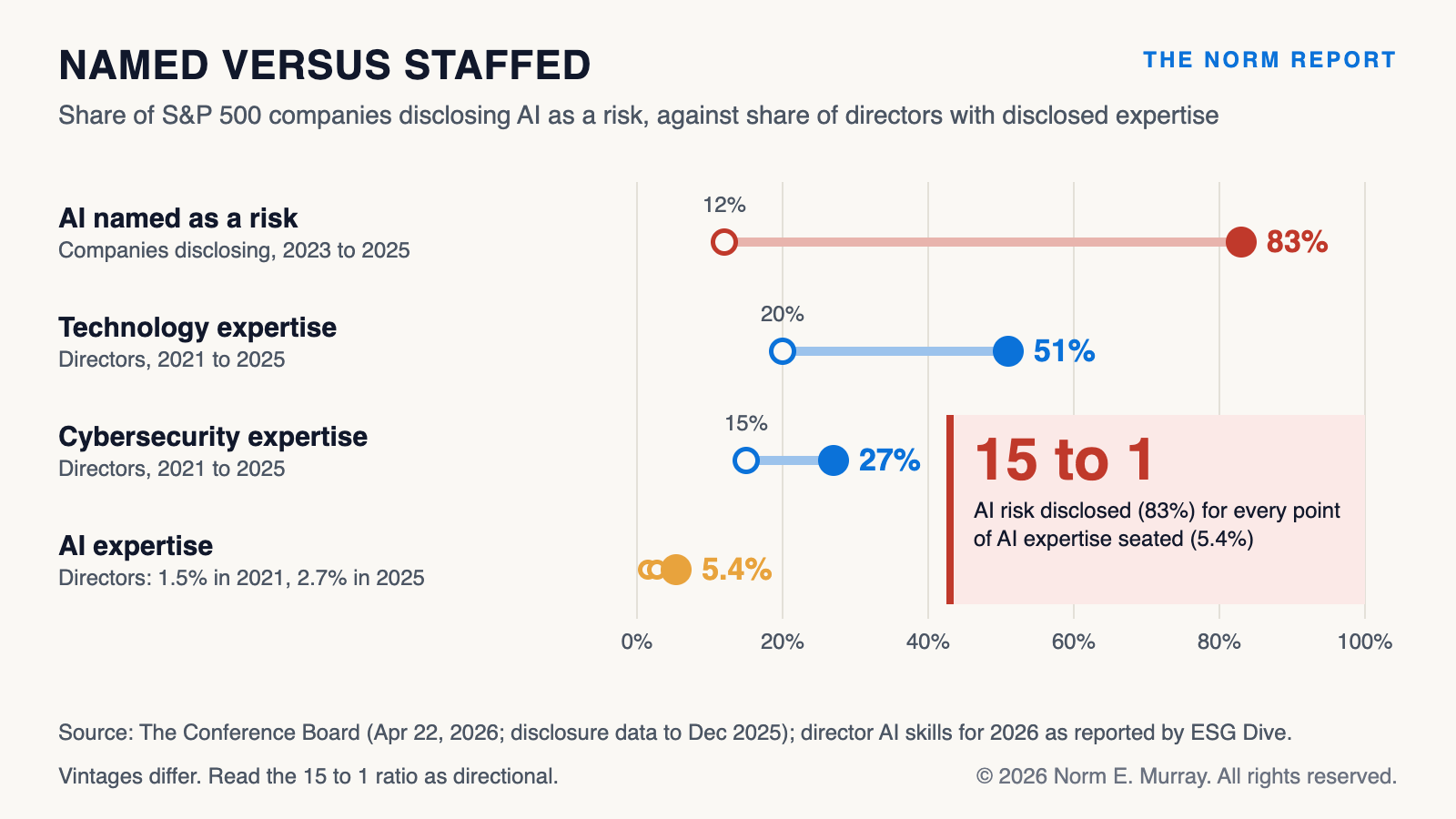
Companies name the risk far more often than boards add the skills to govern it
Source: The Conference Board (Apr 22, 2026; disclosure data to Dec 2025); director AI skills for 2026 as reported by ESG Dive.
Note: Vintages differ. Read the 15 to 1 ratio as directional.
© 2026 Norm E. Murray. All rights reserved.
That asymmetry is the story. A risk factor costs a company a paragraph of counsel’s time. A director who can test the claim underneath that paragraph costs a seat, a search, and a change in how the board talks to itself. Organizations buy the cheap thing first.
Why Doubling Is Not Closing
A doubling sounds like momentum. The arithmetic is less kind. From 5.4 percent, three more doublings are needed to reach roughly 43 percent, and cybersecurity, a risk boards have lived with for a decade, has reached only 27 percent. There is also a measurement problem. A skills matrix is a self-description. Directors list the competencies they believe they hold, and a company has every incentive to read generously.
The supply side is not helping. Conference Board research reports that fewer new directors joined Russell 3000 and S&P 500 boards in 2026, and in its April survey only 21 percent of executives said their company planned to add directors with dedicated AI or technology expertise. Just 26 percent said they would focus on board AI education. Former CEOs remain the most represented category of independent director. These are accomplished people who built their careers on being the most informed person in the room. That detail matters more than it first appears.
A board that adds few seats, and recruits from the pool that built its authority before AI, cannot recruit its way to fluency on any timeline the market will tolerate.
Five Self-Portraits of One Boardroom
Ask who is qualified to judge the board’s AI capability and the answer depends on who is asked. In its 2026 CEOs and Boards survey of 625 leaders, BCG found that 75 percent of board members rate their own AI literacy as sufficient or advanced. Among CEOs, 63 percent said their boards overestimate AI capabilities, and nearly 40 percent said their boards lack an informed view of how AI reshapes growth strategy. The Conference Board’s survey of 130 executives found that only 23 percent call their board highly fluent. BDO’s 2026 board survey found that just 36 percent of directors are very confident their board has the right skills for oversight of AI, cybersecurity and data.
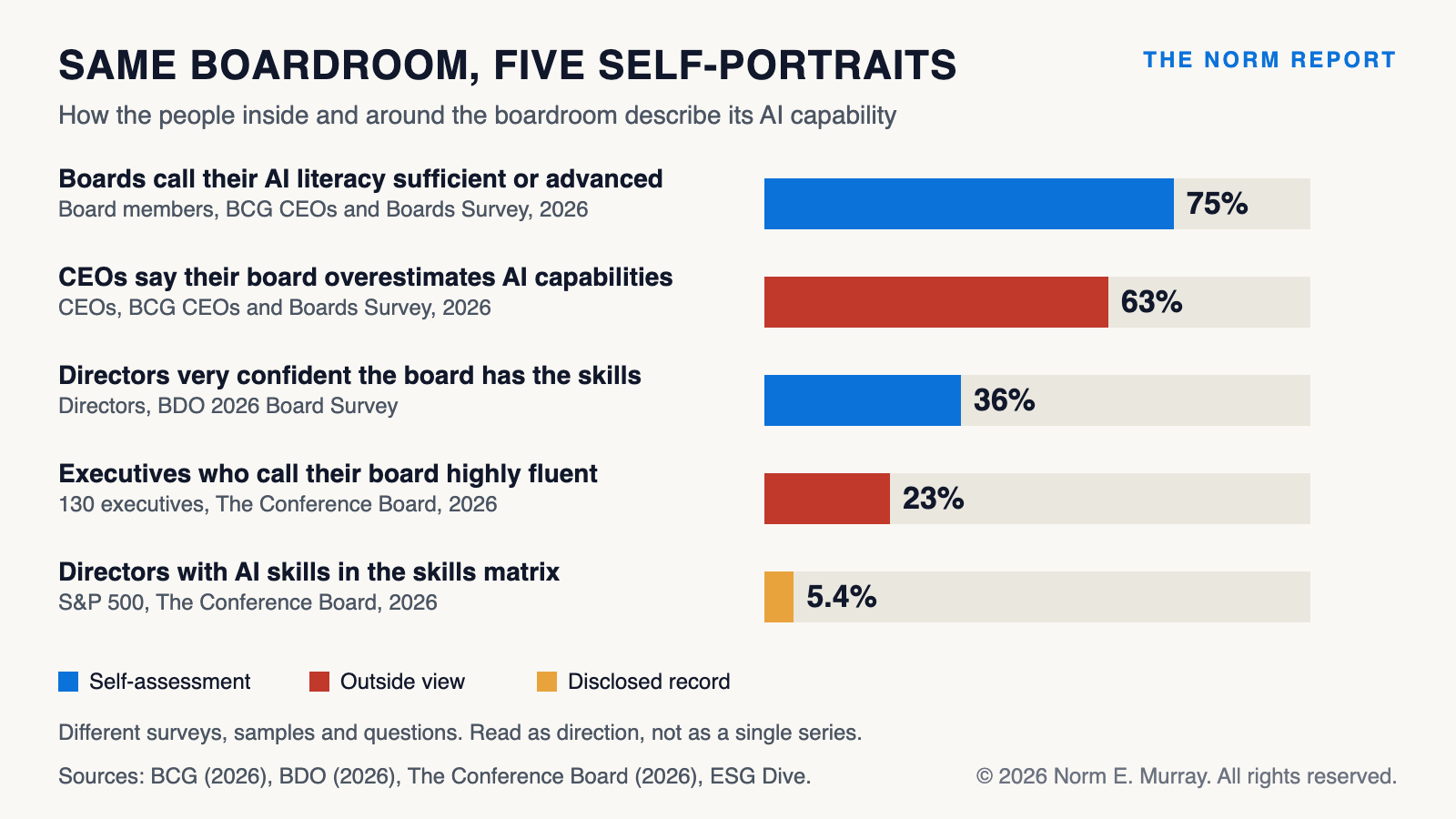
Every group describes board AI capability differently, and the disclosed record is lowest
Source: BCG (2026), BDO (2026), The Conference Board (2026), ESG Dive.
Note: Different surveys, samples and questions. Read as direction, not as a single series.
© 2026 Norm E. Murray. All rights reserved.
Exhibit 2 shows how far apart the five answers sit. These are different surveys with different questions and should not be read as a single series. But the shape is consistent. The closer a judgment sits to the board’s own self-image, the more flattering it is. The further it sits, the less so. And the directors themselves are not blind to the problem. In PwC’s 2026 Annual Corporate Directors Survey, 55 percent of directors said at least one colleague should be replaced, and 49 percent said their board’s assessments are not sufficiently candid.
Directors know. They are not saying so in the room. That is not a skills gap. It is a candor gap, and candor gaps have a well-documented mechanism.
The Mechanism: Pluralistic Ignorance
In 1993, the psychologists Deborah Prentice and Dale Miller published a study of Princeton undergraduates and campus drinking. On average, students were more uncomfortable with the drinking culture than they believed their peers to be. Each assumed that nearly everyone else was at ease. Because nobody spoke, the silence became the evidence, and the norm persisted. The phenomenon is called pluralistic ignorance: every member privately doubts, publicly assumes the others do not, and the group converges on a position no one holds.
Now put that dynamic in a boardroom where AI is on the agenda. A director who cannot independently test a management claim about model risk, vendor concentration, or agent autonomy has a choice. Admit it, and risk looking like the one person who has not kept up. Or nod, and trust that the others have it covered. The others are making the same calculation. The minutes record agreement. The filing records a governed risk.
Three forces reinforce the silence. Goodhart’s Law applies first: once the visible target is a disclosed risk factor, the disclosure stops measuring oversight and starts measuring compliance with the expectation of disclosure. Authority bias follows. Research from the MSCI Institute on AI governance warns of non-expert directors deferring to specialists without independent diligence, and law firm commentary from Debevoise makes the same point about a lone AI expert on the board. Finally, there is principal-agent theory, which predicts the rest. Management holds the information advantage. The board is the principal, dependent on claims it cannot verify, from agents and vendors who are paid when the claims are believed. AI widens that asymmetry because the claims are technical, move quickly, and are often vendor-sourced.
I call the result the Disclosure Illusion: treating a disclosed risk as a governed one. It runs on three components. Paper comfort, because naming a risk in the filing feels like managing it. Status silence, because few directors will confess AI illiteracy in front of peers. And delegated judgment, because the board ratifies management’s AI claims instead of testing them. Exhibit 3 traces how the three components feed one another.
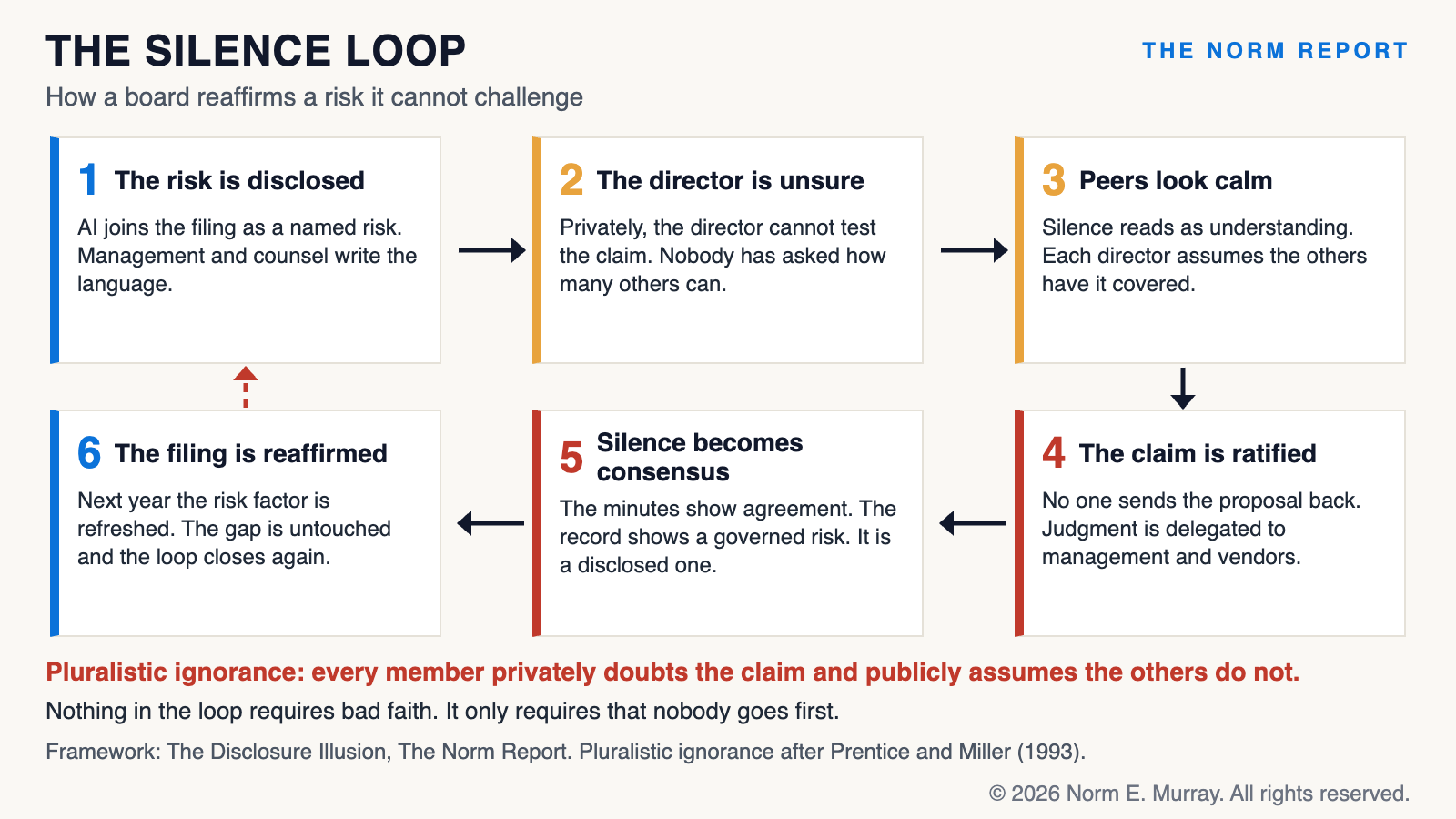
Silence turns a disclosed risk into a reaffirmed one
Framework: The Disclosure Illusion, The Norm Report. Pluralistic ignorance after Prentice and Miller (1993).
© 2026 Norm E. Murray. All rights reserved.
Nothing in the loop requires bad faith. It only requires that nobody goes first.
Ignorance Does Not Make Boards Cautious. It Makes Them Impatient.
The comfortable assumption is that a board short on AI fluency will at least be careful. BCG’s data points the other way. About 60 percent of CEOs believe their boards are rushing AI transformation, and BCG’s analysis links lower self-assessed understanding to board fear of missing out. The pattern is predictable. A director who cannot evaluate a technology can still evaluate the risk of being seen to have missed it. Social proof fills the space where analysis should be. When 83 percent of peers are disclosing, and the market has rewarded the build-out for three years, accelerate is the one position that needs no technical defense.
That produces a perverse division of labor. Management, which understands the technology, is pushed to move faster by a board that does not. The board, which holds the oversight duty, lacks the means to slow anything down or even to ask what is being assumed. The Conference Board’s survey shows what rides on that arrangement. Eighty percent of executives expect sustained productivity gains from AI across the economy within three years. Seventy-five percent expect large-scale disruption of employment and workforce structures over the same period. Fifty-eight percent name cybersecurity and data breaches as the most significant AI-related risk to their company. And only 9 percent say their company is very prepared to comply with AI regulation.
Those are four material claims: a productivity thesis, a workforce thesis, a security exposure and a compliance posture. Each needs someone in the room who can look at the number and say that it does not reconcile. A board of people who are all privately unsure, and all publicly calm, cannot supply that person. It can only supply the signature.
Disclosed Is Not Governed
If governance is a ladder, the public record covers only the lower rungs, as Exhibit 4 shows. A risk is named, and 83 percent of S&P 500 companies reach that step. It is staffed, and 5.4 percent of directors do. It is judged fluent, and 23 percent of executives would say so of their board. Then the data runs out. Has any board sent an AI proposal back to management? Has a director’s challenge changed an AI decision? I could not find a published benchmark for either. Those are the two rungs where governance actually lives, and they are the two that no survey is counting.
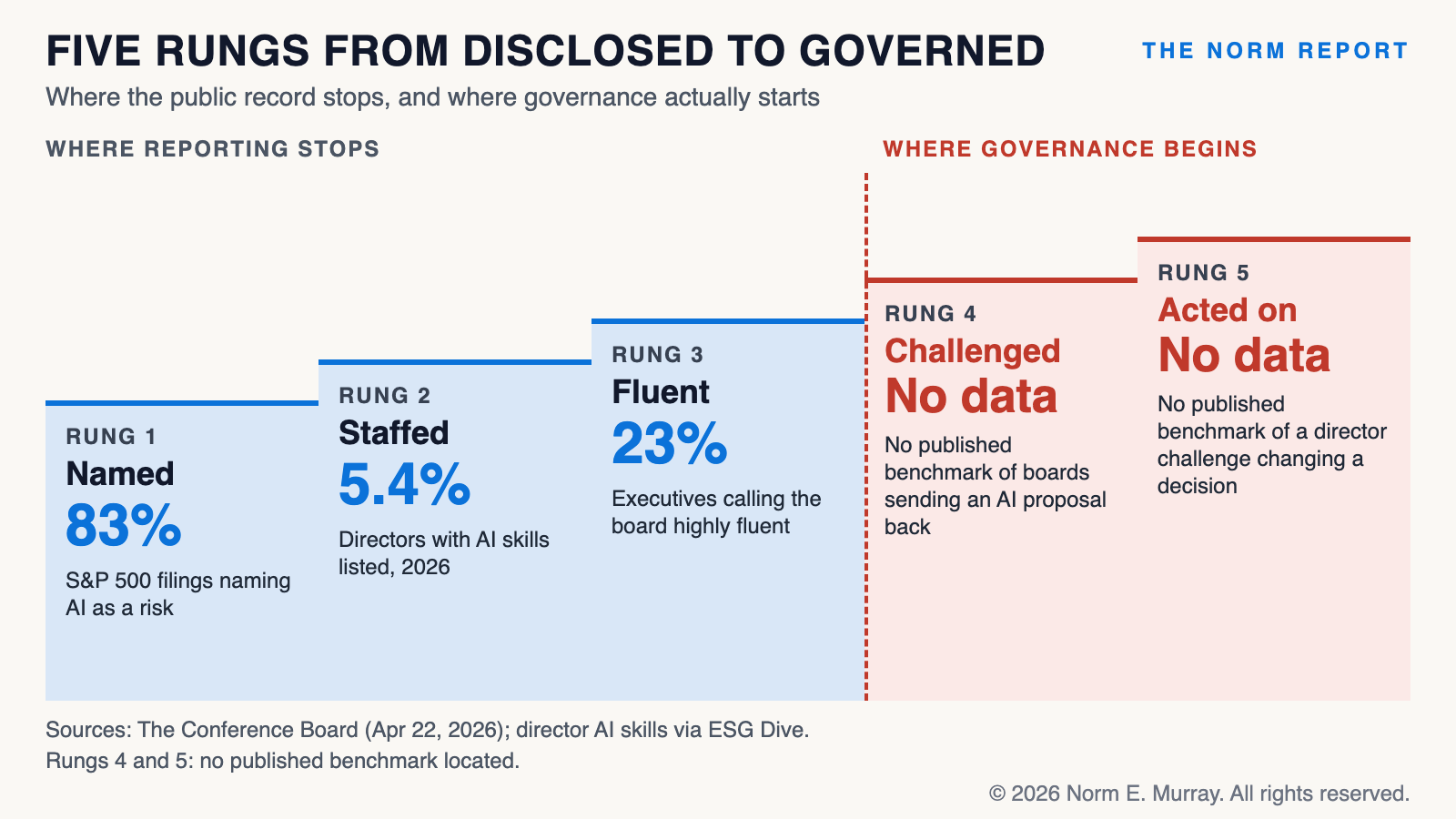
Reporting stops at rung 3; governance begins where no benchmark exists
Source: The Conference Board (Apr 22, 2026); director AI skills via ESG Dive.
Note: Rungs 4 and 5: no published benchmark located.
© 2026 Norm E. Murray. All rights reserved.
The silence has a practical cost beyond the boardroom. PwC’s 2025 director survey found that two-thirds said their board should spend more time on AI, but fewer than half said their board had an approach to overseeing it. That is intent without mechanism, which is exactly what plaintiff’s counsel looks for.
The legal doctrine is worth stating carefully. Delaware’s Caremark standard, which governs board oversight liability, sets a very high bar. It requires bad faith, not a bad outcome. As of this autumn, no Delaware court has applied it to an AI fact pattern, and attorneys quoted by the Daily Journal in October said no directors have yet been sued over AI oversight. That is a statement about the past. The 2019 Marchand v. Barnhill decision, involving an ice cream maker and food safety, let an oversight claim proceed against directors of a company that had no board-level system for a mission-critical risk. Now consider what discovery would turn up at a company whose board called AI a material risk in its filing and could not show anyone testing the claims beneath it. A disclosure that names a risk is also a record that the board knew. This is not legal advice. It is a description of the exhibit a lawyer would be handed.
What the Market Just Priced
Return to November 5. A risk that moved $2.5 trillion of market value in a day is being supervised by bodies that meet a handful of times a year, working from materials prepared by the people whose claims they are meant to test. Fitch warned the same week that a significant share of planned data center capacity could face regulatory hurdles under incoming governors in Texas, Georgia and Ohio. The exposure is not only to the trade. It runs through power, permitting, vendor concentration, and a workforce that, in The Conference Board’s own survey, three quarters of executives expect AI to disrupt on a large scale within three years.
None of those questions is answered by a risk factor. Each needs a director who can look at a management claim and say that it does not reconcile. Markets do not reward disclosure. They price governance, and they price it after the fact, at a worse rate than a board would have paid for it in advance.
Why the Obvious Fix Is Not Enough
The reflexive answer is to recruit an AI expert. It is a reasonable move and a risky substitute. The pool is thin: MSCI’s analysis found only about 2 percent of individual directors qualify as AI experts. A lone specialist invites the deference problem described above, with every other director relieved that someone else has the file. And as Fast Company’s recent treatment of the issue puts it, expertise is something a board has, while oversight is something a board does. A résumé can prove the first. Only behavior proves the second.
Three tests separate a board that governs AI from one that discloses it.
Can any director defend each AI risk disclosure in their own words? Not read it, defend it. If the answer is the general counsel, the risk belongs to counsel, not to the board.
When did the board last send an AI proposal back? A board that has never returned one is not being persuaded. It is being managed.
Who tells the board it is wrong, and through whom do they report? An independent technical voice that reaches the board through management is not independent.
These are not steps in a program. They are diagnostics, and the discomfort they produce is the signal. A board that finds them easy has probably not tried them.
The Number That Will Move
The 15-to-1 ratio will close. The open question is whether it closes by design or by incident. Cybersecurity earned its board seats through a series of public breaches. AI is moving faster, and it has already given the market a taste of its volatility. The boards that act now will not need the lesson delivered by an event. The rest will learn the way the market taught it on November 5, in a single session, with the whole index watching.
The disclosure is already written. The governance is still optional, until someone with standing asks to see the evidence.
I work with CEOs, CHROs and board chairs on exactly this gap: where AI claims have outrun the capacity to test them, and how to build the candor that real oversight depends on.
Sources: The Conference Board, “In the S&P 500, Disclosure of AI Risks Surges from 12% to 83%” (April 22, 2026), and 2026 director data reported by ESG Dive (November 2026); Reuters via GV Wire, “Blue Tsunami Wipes Out $2.5 Trillion From Nasdaq” (November 5, 2026); BCG, Split Decisions: The BCG CEOs and Boards Survey (2026); BDO 2026 Board Survey via CDO Magazine (October 20, 2026); PwC 2026 Annual Corporate Directors Survey (September 23, 2026) and 2025 survey via Fast Company; MSCI Institute, AI Governance: From Director Expertise to Board Effectiveness (2026); Debevoise & Plimpton via Society for Corporate Governance (April 29, 2026); Daily Journal, “AI puts corporate boards on notice” (October 19, 2026); Prentice and Miller (1993), Journal of Personality and Social Psychology; TMGM market analysis (November 5, 2026).